
OREGON TRAIL
Because of the treacherous rapids along the central Oregon stretch of the Columbia River, the Oregon Trail dropped about 17 miles south of the Columbia, following a sandy route through bunchgrass and sagebrush. The Oregon Trail entered Sherman County at the McDonald crossing of the John Day River, about 10 miles east of Wasco.
A fork in the Oregon Trail occurred just after exiting the canyon of the John Day River. Most emigrants went west at the fork to go to The Dalles, but a few went southwest at the fork, down Grass Valley Canyon to the Deschutes River, and on to the Barlow Road crossing.

RAILROAD ERA
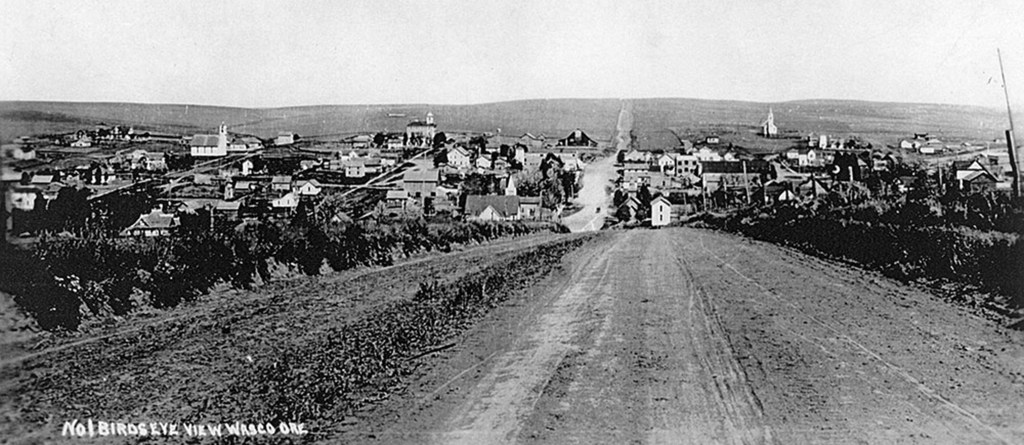
In 1897, the Columbia Southern Railway reached Wasco, and the train station was built in 1898. The population within the city limits was 300 living in 55 residences. At that time, the city had a single telephone and electric power provided by a steam plant.
With the advent of the auto, roads followed, influenced by Samuel Hill, son-in-law of railroad magnate James J. Hill, who also played a key role in Oregon’s development. The Sherman County Highway was completed by 1924 as a result of Wasco’s efforts in selling city bonds for curbing and grading.
It was also thought that the Columbia River Highway would go through Wasco. However, development and growth followed the Columbia River, and Wasco remained primarily an agricultural service center. The devastating floods of 1964 destroyed many of the railroad trestles and tracks along the Deschutes River and in Sherman County, bringing an end to railroad service in Wasco. The rails were taken up in 1966.
THROUGH THE YEARS
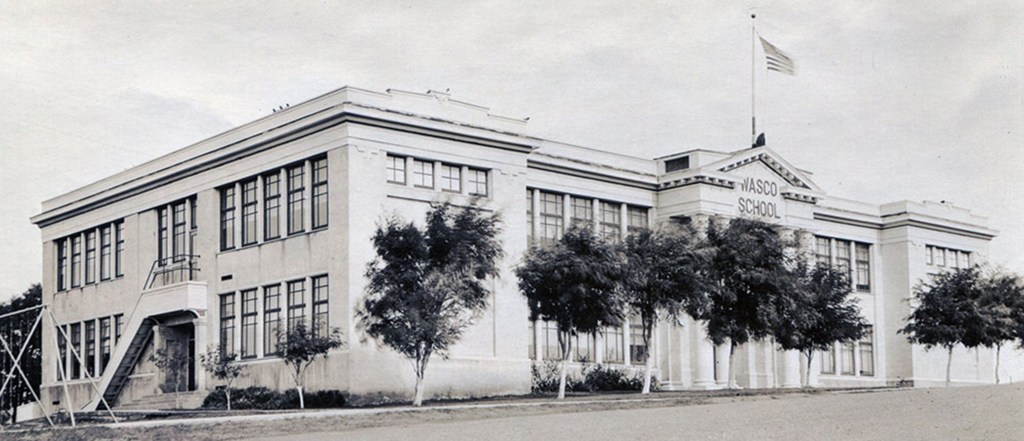
The first settler at the current Wasco location was Clark Dunlap in 1879. By 1883, the town had residences, a church, blacksmith and machine shops, and a flour mill. A drug store was built in 1885, the Oskaloosa Hotel in 1887. The first school was built in 1888, and the first bank was established in Wasco in 1890.
By 1898, the town was thriving and its population had doubled.
Like most cities of its era, Wasco suffered a disastrous fire, in 1903, losing a sizeable store, the Wasco Opera House and residences. As a result of the blaze, Wasco began to build its fire, water and sewer systems. Wasco had to reincorporate in 1905 after learning the original incorporation was handled incorrectly.

The Sherman Hotel was built in 1917, based on speculation that a new state highway to the Columbia River would pass through Wasco. The Hotel burned down in 1928 and was rebuilt, only to burn again in 1956. In 1921, a central electric power system was introduced. By 1939, a farmer-owned co-op was bringing power from the Bonneville Dam.
Businesses in Wasco have included a weekly newspaper, three hotels, an opera house, schools, churches, two banks, two flour mills, warehouses, shops and general stores, implement dealers, a livery, a millinery shop, a lumber yard, brick yard, two hospitals, a dentist, doctors, lawyers, several restaurants, saloons, a bakery, a cigar shop and two barber shops. By 1982, a post office had served the town of Wasco for 100 years.

A RICH HISTORY FOR 10,000 YEARS
Our region was home to a thriving native population for thousands of years before Euro-American fur traders and settlers arrived. Some of the area’s original inhabitants were members of the Wasco-pam tribe, the descendants of whom are now part of the Confederated Tribes of Warm Springs.
The name Wasco is said to be derived from the indigenous word wacq-o, meaning a cup or small bowl made of horn. Tribes from across the Northwest came together peacefully every year to fish, trade, and socialize. The iconic Celilo Falls served as a gathering place. In the 1800s they were joined by the mountain men fur traders and French-Canadian boatmen of the Hudson’s Bay Company.
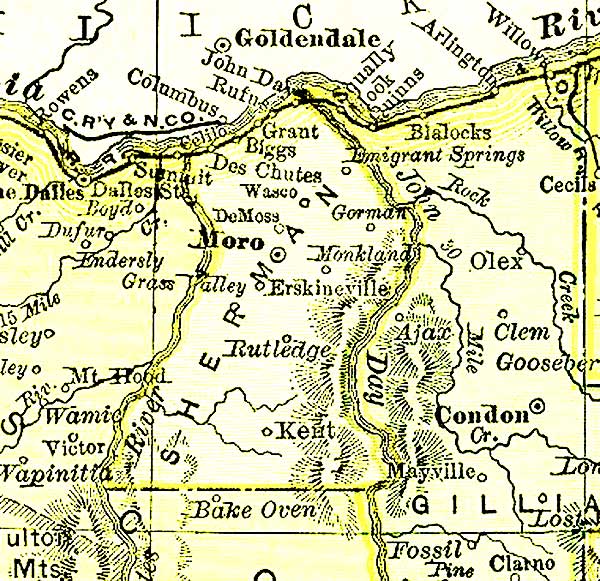
When Wasco County was created in 1854, it comprised all of Oregon Territory between the Cascade Range and the Rocky Mountains. Over the years, 17 other counties in eastern Oregon were created from Wasco County, including Sherman County to its east. Wasco County is bordered by two rivers, the Columbia to the north and the Deschutes to the east, and by the Warm Springs Indian Reservation on the south and Mt. Hood National Forest on the west. Wasco County shares political boundaries with Sherman, Wheeler, Jefferson, Clackamas, and Hood River counties.
OLD MAP OF SHERMAN COUNTY
 City of Wasco, Oregon